

Skip to content
Community & Place

We deliver active modes design, sustainable transport and community engagement.

Digital & Spatial Technology

We create efficiencies with our spatial, software development, and digital engineering solutions.

Road Safety

We support positive safety outcomes from the street to the transport network.

Strategy & Planning

Delivering business cases, traffic modelling, economic assessments, and public transport innovation.

Transport Design & Engineering 

We deliver designs through collaboration with practitioners to shape transport solutions.

Land Development

We apply our transport expertise to support clients through the land development process.

CarbonWise

Measure your employee’s commuting emissions.

SafeSystem

A data-driven approach for road safety practitioners to identify risks.


TrafficFlow

Quickly and easily get detailed traffic and mobility data.

Partner Products

We partner with TomTom and HERE to provide transport and traffic data solutions.


More Products

Discover more of our unique products

Our Insights

Read our insightful blogs providing the latest information and trends.

Featured Projects

The work we do helps inspire positive change.

News

Find out what we are up to. 

Research

Applying our research expertise to provide practical based solutions.

Videos

Explore our Webinars and Video Series.

Our Team

Our team of skilled professionals provide insightful solutions and empowering advice.

Our Story

Since 2003, we’ve been providing transport solutions in New Zealand and internationally. 

Our Commitment

We’re connected and committed to our people, the community and the environment.

Our Partners

We work closely with our partners to make a meaningful impact.

Our Awards

We showcase our awards to celebrate our people and clients.

SafeCurves

Identify high-risk horizontal curves and support more targeted, evidence-based road safety investment.
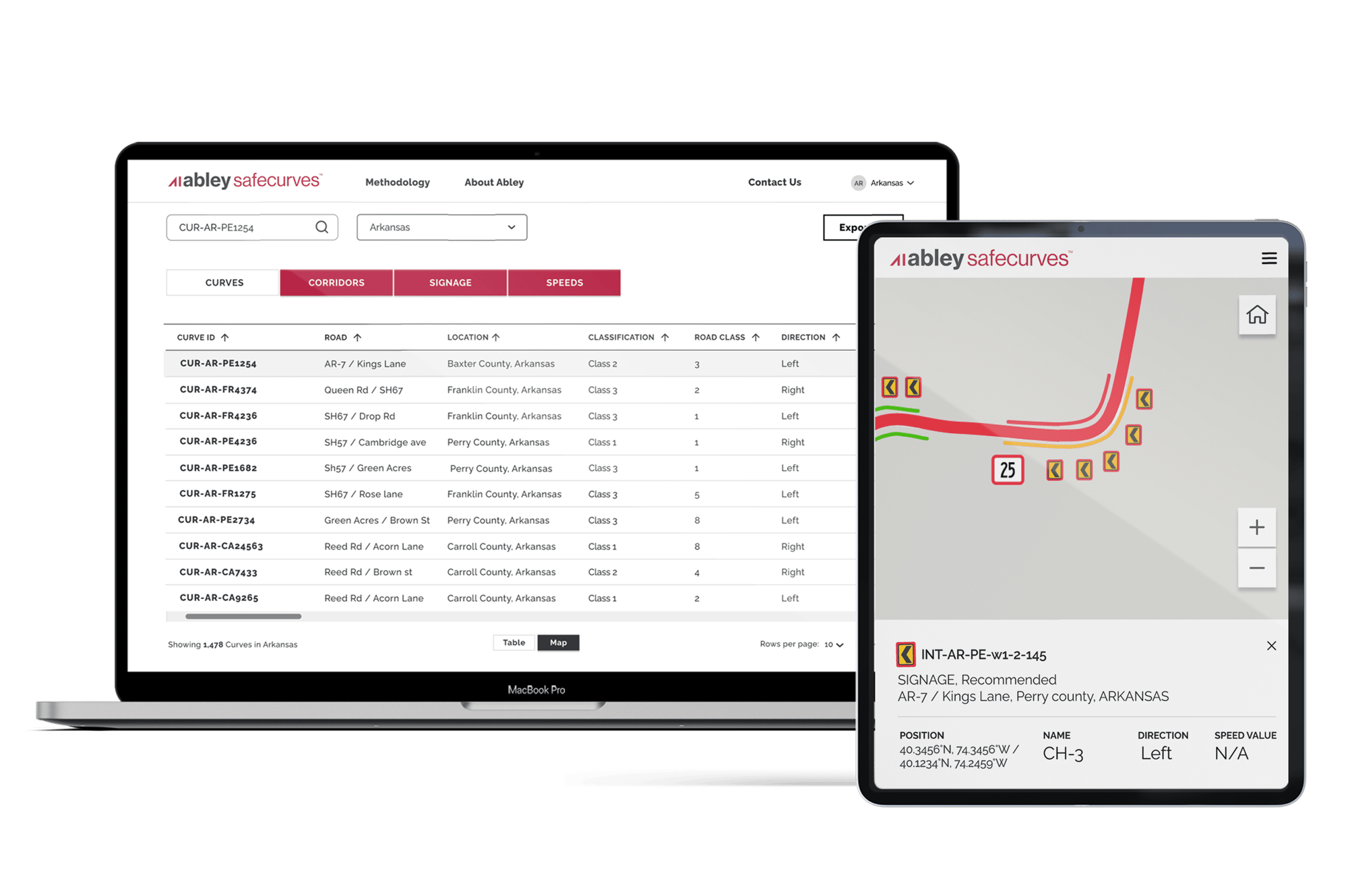
Abley SafeCurves app


A proactive approach to managing road safety

SafeCurves is a data-driven road safety solution that helps state DOTs, county road agencies and road safety practitioners identify, prioritize and address high-risk horizontal curves across road networks.

Using a Safe System approach, SafeCurves helps agencies assess crash potential proactively and support more consistent road safety decision-making.
Who is SafeCurves for

SafeCurves is designed for organizations responsible for improving road safety outcomes across road networks, including:

  • state DOTs

  • county road agencies

  • road safety practitioners

  • traffic engineers

  • GIS and network safety analysts

  • transportation teams responsible for rural and high-speed roads

It is particularly valuable for agencies seeking a practical and scalable way to support more consistent network safety planning and target road safety investment across rural and high-speed road environments.


Abley SafeCurves Professional homescreen

Systemically and proactively identify and address risks

SafeCurves helps agencies identify and address risk systematically so safety improvements can be planned with greater confidence, consistency and efficiency. 

Data-Driven Risk Assessment

Proactively assess risk based on crash potential, not just crash history.

Targeted Investment

Direct investment to locations with the greatest potential for impact, ensuring efficient use of resources.

Effective Treatments

Deliver uniform, consistent treatments that comply with Federal standards.

Time Savings

Save time compared to traditional in-field inspections.

Immediate Data Availability

Access data instantly and seamlessly integrate it with your existing processes.

Learn how SafeCurves can help your organization


Book a call  ›

“We would highly recommend SafeCurves to other DOTs because it’s a compelling solution that can significantly benefit a state’s approach to Road Safety.”

Adnan Qazi, P.E.Staff Traffic Safety Engineer

Key product features

SafeCurves combines data-driven analysis, practical delivery formats, and Evidence-Based outputs to support safer decision-making across road networks.

  • Identify locations for improvement - Evaluate horizontal curves using risk factors such as speed context, geometry, terrain, and superelevation to highlight locations with elevated crash potential.

  • Prioritize corridors for investment - Categorise corridors based on risk so agencies can focus resources where safety improvements are likely to have the greatest impact.

  • Design targeted interventions - Support intervention planning with advisory speed and warning sign outputs aligned with federal standards and road environment context.

  • TomTom centerline data - Use high-quality TomTom road centerline data as the foundation for network-wide assessment and analysis.

  • GIS integration - Access and view SafeCurves outputs through your preferred GIS platform, the SafeCurves app, or geodatabase delivery.
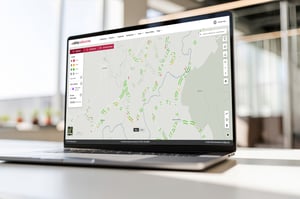
Abley SafeCurves Identify
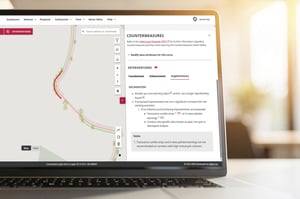
Abley SafeCurves Interventions countermeasures
What SafeCurves outputs

Depending on the module and delivery format, SafeCurves can support agencies with:

  • risk-classified horizontal curves

  • prioritized corridors and locations for investment

  • intervention planning insights

  • advisory speed and warning sign outputs

  • GIS-ready data layers

  • GDB delivery for further analysis and integration

These outputs help agencies move from network assessment to practical planning with greater confidence and consistency.

The Safe System Approach to saving lives

The Safe System Approach is underpinned by five pillars, including that safety must be proactive. This means identifying and addressing risk before crashes occur.

Horizontal curves are one of the most challenging features on high-speed rural roads, and the risk they present is not always visible through crash history alone.

SafeCurves supports this proactive approach by helping agencies identify crash potential across an entire roadway system, reducing reliance on reactive decision-making and supporting more consistent road safety investment. 

Winding road sign USA
Horizontal curved rural road in Texas USA

Did you know the U.S. has over 900,000 horizontal curves
that are out-of-context with the road environment?

In 2021, 42,939 people died on America’s roads. A large proportion of these deaths were associated with crashes on horizontal curves.  

Horizontal curves are one of the most challenging features on high-speed rural roads. The average crash rate on horizontal curves is approximately three times higher than straight sections of road (FHWA, 2023). 

Drivers can be surprised by curves that are inconsistent with what they are expecting, elevating the risk of roadway departures and head-on collisions. These types of curves are regarded as ‘out-of-context’ – the sharpness of the curve is out-of-context with the driver’s experience prior to reaching the curve.  


Examples of out-of-context curves include:  

  • an isolated curve on an otherwise long and straight road;  

  • the first curve entering a series of curves; and  

  • an unexpectedly sharp curve among a sequence of larger-radii curves.  


  • What causes crashes?
  • How might we mitigate crashes?
  • How can we identify improvements?

What causes crashes on horizontal curves?

Research suggests that the primary causes of crashes on horizontal curves include:  

  • complex geometry;  

  • excessive speed;  

  • drivers’ unawareness or misjudgement of the approaching curve; and 

  • environmental conditions, such as visibility or weather.   

How might we mitigate crashes on horizontal curves?

There are several low-cost countermeasures which can reduce the risk of drivers leaving the roadway on a curve. These include line markings, curve advisory speeds, warning signs and improving the skid resistance of the road surface. Widening the shoulder and installing roadside barrier also minimizes the severity of a crash, should a loss of control occur. 

How can we identify horizontal curves for improvement?

Site analysis 

Traditionally, identifying curves for safety improvements involved looking at crash data to find blackspots and trends. Many high-risk curves were only treated after a serious crash had occurred. This approach is reactive, as you need crashes to occur before you can address deficiencies. Chasing crash hotspots fails to address sites where serious crashes could occur in the future. This effect is magnified on low-volume rural roads where crashes are relatively rare and are dispersed across the road network. 

Moving to a systemic approach 

Rather than waiting for crashes to occur, the systemic approach proactively evaluates risk across an entire roadway system. It is focused on looking for characteristics which are frequently present in severe crash types – for example road geometry or traffic volume. By using a systemic approach, we can identify improvements based not only on crash history but also on crash potential.  

Gain road safety insights with our FREE Diagnose Report

Uncover the scale of your road safety challenges for your jurisdiction with SafeCurves.

Or request a Diagnose report for your county or state here.


Frequently asked questions

How do you categorize the curves? 

SafeCurves categorizes curves into Class 1, 2 or 3 depending on whether they are: 

  • unacceptable (Class 1)

  • undesirable (Class 2)  

  • desirable (Class 3)

  • uncategorized (Class 4)

The design limit is determined by the combination of the approach speed, and the curve radius. For example, a tight radii curve can be desirable if drivers approach it at a low speed, or unacceptable if drivers approach it at high speed.  

The ‘undesirable’ and ‘unacceptable’ design limits are considered out-of-context, with ‘unacceptable’ being more out-of-context than ‘undesirable’.  

How have you validated the data? 

SafeCurves: Identify has been applied to all high-speed ≥40mph roads in the USA covering approximately 213,000 miles of roads and identifying over 1,725,000 horizontal curves.   

The outputs have been validated against data contained in the National Highway Traffic Safety Administration (NHSTA) Fatality Analysis Reporting System (FARS).   

While only 2% of the network was classified as ‘unacceptable’ curves, this category of highway had the highest average number of fatal crashes. The fatal crash rate on ‘unacceptable’ curves is 1.4 times that of ‘desirable’ curves and 2.1 times that of straights. This suggests that ‘undesirable’ and ‘unacceptable’ curves are high-risk curves. The implication is that targeting interventions at high-risk curves will yield greater road safety benefits and provide a greater return on investment. 

Is SafeCurves available now? Yes. Book a demo or contact us to find out how to access the data for your location. 
How is the service provided? 

SafeCurves is provided via an access key so that you can either use the SafeCurves App on your desktop or mobile device and via your preferred GIS platform, or you can access the data as a GDB.

How is the data kept up to date?

The data is supplied in perpetuity.  At the conclusion of the Plan term there is an opportunity to renew, and the data is updated to the current methodology version.

What do you use as your base data? SafeCurves uses TomTom centerline data as a core input for network-wide analysis.


Book a call

Book a call with Steve to discuss your organization's challenges and learn how SafeCurves can deliver effective solutions.


We are passionate about inspiring positive change.

Abley is a specialist New Zealand-owned transport planning, road safety and geospatial technology company. Founded in 2003, we work across the U.S., Canada, New Zealand, Australia and Indonesia, supporting government agencies at national and local levels as well as large organizations.  

Abl23_06-1024x683