

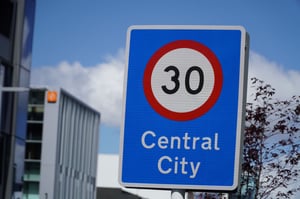
As part of our work on an upcoming update to the Austroads Guide to Road Safety Part 3: Safe Speeds, Abley undertook a Review of Speed Management Evidence and Guidance (available now on the Austroads website).
To inform this work, we interviewed experts across a range of contexts and locations. These conversations provided valuable insights into how speed management actions are identified, how implementation plans are shaped and how communities respond to different approaches. Together, these lessons have helped us understand the pathways from policy to practice, and how they can be translated into effective guidance.
Global examples covered in our interviews included:
-
Experiences implementing New Zealand’s Road to Zero Road Safety Strategy, particularly the Tackling Unsafe Speeds programme, from 2020 to 2023
-
Insights from studying over 40 European cities which have introduced 30km/h speed limits in recent years
-
Wales’s landmark 2023 decision to introduce a default 20 mph (30km/h) limit on all restricted roads, reshaping urban environments
Insights from Europe
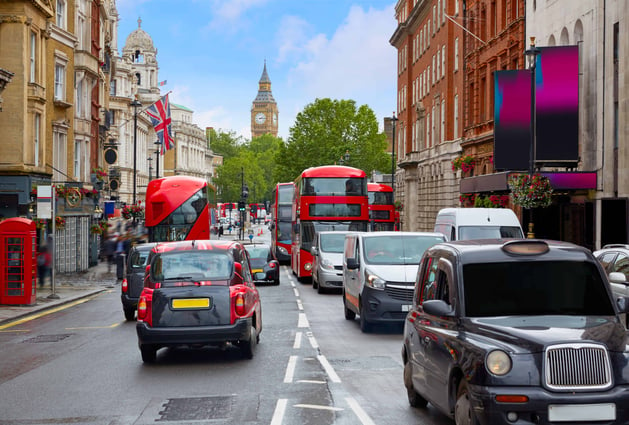
30km/h urban speed limits continue to gather momentum around the world, led by Europe, where dozens of European cities now enjoy improved safety, liveability and other benefits thanks to lower speeds. Synthesising the findings from a broad range of these cities has helped capture valuable lessons and made the benefits more visible. Link to 30km/h cities by George Yannis.
Lessons learned
-
Behaviour change requires a full system approach. Infrastructure, vehicle standards and enforcement must work together; campaigns alone cannot shift behaviour.
-
Street design is foundational. Narrow, traffic calmed streets reduce speeding naturally and send a clear message about expected behaviour.
-
Vehicle technology reinforces safe norms. European Union wide standards such as ISA help normalise compliance and reduce reliance on individual driver judgement.
-
Visible enforcement matters. Without police presence, the public interprets limits as optional. Enforcement must be framed as life saving, not punitive.
-
Campaigns must match the scale of counter messaging. The automobile industry invests heavily in pro speed narratives; safety campaigns must be equally sophisticated.
-
Alliances strengthen legitimacy. Partnerships with insurers, experts and community voices help counter industry pressure and broaden support.
-
Monitoring and evaluation must be transparent. Publishing results builds trust, shows seriousness and helps refine measures without blame.
-
30km/h limits only work where the system supports them. Dense cities, strong public transport and cultural norms make blanket limits viable in Europe but not easily transferable elsewhere.
What went well and key observations
-
Integrated system initiatives created strong foundations. Infrastructure changes, vehicle standards and enforcement aligned to shape consistent expectations for drivers.
-
System alignment is the real driver of change. Infrastructure, technology, enforcement and communication must be sequenced and mutually reinforcing.
-
National strategies provided coherence. European Union level guidance and country level action plan offered clear roadmaps, KPIs and baselines for progress.
-
Monitoring improved credibility. Regular reporting demonstrated where lives were saved and which measures were most effective.
-
Alliances amplified safety messages. Collaboration with insurers and non government actors helped counterbalance commercial pro speed narratives.
-
Behind the scenes alignment is essential. This is especially true with police, who can be inclined to sympathise with speeding drivers and need to be brought on side rather than assumed as natural allies. Experts, ambassadors and community voices help reinforce the narrative once this alignment is in place
-
Political leadership is strengthened by evidence. European Union wide standards, international examples and strong monitoring frameworks give leaders confidence to act.
-
Evaluation must also be politically digestible. Macro level trend reporting helps leaders accept findings without feeling personally blamed.
-
Targeted campaigns supported behaviour change. National messages were reinforced with tailored communications for schools, cyclists and rural communities.
-
Public acceptance grew over time. In cities like Paris, compliance increased significantly after two years as people adapted to consistently slower traffic speeds.
-
Acceptance followed lived experience. Once people experience consistently slower traffic, resistance declines and norms shift.
-
Cultural context matters. Europe’s dense cities, strong public transport and slower movement norms underpin the success of 30km/h speed limits.

Insights from New Zealand
Key findings focus on the 2020 to 2023 period, when New Zealand began implementing Road to Zero, a road safety strategy for 2020 to 2030. At the same time, a new Land Transport Rule: Setting of Speed Limits 2022 (the Rule) replaced the Land Transport Rule: Setting of Speed Limits 2017 and introduced Speed Management Plans to encourage local government leadership. The new Rule made the setting of speed limits more efficient for Road Controlling Authorities by enabling a network approach rather than a piecemeal, road-by-road approach, and sought to improve speed management planning and consultation. Following a change in government, the Road to Zero Strategy was replaced in 2024, and the Rule was subsequently replaced by the Land Transport Rule: Setting of Speed Limits 2024, resulting in fewer speed limit setting options and requirements than under the Strategy.
New Zealand's experience shows that implementing speed management reform depends on political and public support as much as technical design.
Lessons learned
-
Public sentiment runs deep. Speed limits are closely tied to people's sense of identity and autonomy and to the local context they live in. Communities often feel more strongly about speed changes than expected, and underestimating this created challenges.
-
Local government needs licence to act. While the Rule encouraged local government leadership, councils were closest to their communities and were often ready to move faster than the framework allowed. Giving them a clearer mandate earlier would have let this readiness translate into faster progress.
-
The concept needed better storytelling. New Zealand had strong evidence and successful case studies, but these weren’t used effectively to build public understanding or demonstrate lives saved.
-
The messenger matters. Trusted voices such as paramedics, former police and community leaders could have been used more deliberately to get cut through and put a human face to the issue.
-
Consultation needed to be more direct. The public are used to open-ended consultation processes, which can create an expectation that outcomes are still up for negotiation. A more direct approach, clearly explaining that decisions were based on safety evidence, would have better managed public expectations and understanding.
-
Momentum matters. Long debates allowed opposition to grow. Moving with more pace and intent would have reduced uncertainty and helped keep the focus on safety outcomes.
-
Implementation must be pragmatic and sensitive. Stronger engagement through regional networks and better understanding of local perceptions would have supported smoother rollout.
-
Partners must speak with one voice. A shared narrative and joint vision across agencies are essential to maintain legitimacy and avoid mixed messages.
What went well and key observations
-
Local government leadership delivered results. Councils acted quickly and achieved strong safety outcomes because they understood their communities and had the mandate to act.
-
School-focused changes built broad support. Slower speeds around schools were widely accepted and helped build a compelling case for wider change.
-
Road to Zero provided a strong strategic anchor. The national strategy offered a coherent framework across the Safe System pillars, giving political leaders and practitioners a clear roadmap, even if the narrative could have been communicated more powerfully.
-
Political confidence was built on evidence and precedent. Confidence to advance speed management work came from the road map set out in the Road to Zero strategy, from work already carried out by previous transport leaders and from international examples of speed management in practice.
-
Broad alliances matter. Support from multiple sectors reduced the risk of political isolation and strengthened the mandate for change.
-
Partnerships improved over time. Road safety partnerships initially struggled to reach their potential, with timing complicated by the aftermath of Covid and resources diverted elsewhere. This improved once there was more focus on governance structure, with operational heads established and performance tracked against organisational responsibility.
.jpg?width=641&height=426&name=shutterstock_1408767728%20(1).jpg)
Insights from Wales
In September 2023, the Welsh government introduced the default 20 mph speed limit, changing every urban residential that had a 30 mph limit to 20 mph unless it was given an exemption by the local authority. Essentially, almost everywhere people lived in Wales now had slower speed limits. This new law meant that Wales was the first nation to impose 20 mph as the default speed limit on all restricted roads. In 2025, Welsh councillors backed proposals to reverse 20 mph speed limits on 52 roads following a public consultation. Key findings focus on the 2023 to 2024 period.
Lessons learned
-
Bring Local Authorities in earlier. Many councils were hesitant to lead consultation due to limited capacity and fear of backlash. Earlier involvement would have strengthened confidence and ownership.
-
Align early with road safety partners. Police did not initially view speed changes as a policing priority, and a lack of resourcing, compounded by Covid, meant there was a reluctance to put police in the way of public opposition. Earlier alignment would have avoided gaps in delivery.
-
Choose the right people to front the change. Engineer led agencies were not always the best messengers for cultural change. People skilled in engagement and behaviour change would have improved cut through.
-
Acknowledge the emotional dimension. Speed limits interact with peoples’ sense of identity and autonomy. People needed to understand why the change was happening, not just the evidence behind it.
-
Expect strong early pushback. Petitions reached two million in the first two weeks, silencing supporters. Monthly sentiment tracking later showed attitudes softening, reinforcing the need to manage expectations and stay the course.
-
Invest in communications early and at scale. Communications were significantly underfunded (£1m vs £32m for engineering) and began a year too late. Covid further constrained authentic engagement.
-
Messaging must normalise, not alienate. Emotional appeals used by behavioural experts didn’t land, especially on social media, and in some cases backfired.
What went well and key observations
-
Effective local partnerships. Some Local Authorities partnered with schools, and Fire Service teams delivered roadside awareness courses that were well received and helped build trust.
- Road safety gains are already visible. More than half of drivers are travelling under 24 mph, with aggressive driving and tailgating almost disappearing. Most people are now driving below 30 mph, demonstrating meaningful behavioural change and early success of the policy shift.
- Monthly sentiment tracking showed attitudes softening. Key to manage expectations and stay the course.
Summary
Across Europe, New Zealand and Wales, a clear pattern emerges; speed management succeeds when system design, political leadership and public engagement reinforce one another, though each context shapes how these elements come together.
What’s consistent across all three examples is the need for coherent and proactive coordination that supports slower speeds, credible enforcement, clear communication and aligned partners. All regions also show that public acceptance grows over time, especially once people experience the benefits and early safety gains become visible. And in every case, the messenger matters: trusted voices and strong alliances help counter resistance and build resilience and legitimacy.
Where they differ is in how the system supports behaviour change. Europe benefits from dense cities, strong public transport and long standing cultural norms that make slower speeds feel natural. New Zealand’s more dispersed networks and strong car culture mean public sentiment plays a larger role, and political leadership must work harder to build understanding and momentum. Wales sits somewhere in between. Its nationwide 20 mph shift shows the power of decisive policy, but also highlights the risks when communications, local alignment and enforcement aren’t fully in place from the start.
Together, the three examples show that while the principles of successful speed management are universal, the pathways to implementation must be tailored to local culture, political context and system readiness.