

 Don't Wait for Graham" style="object-fit: cover;object-position: top;width:100%;height:100%;" fetchpriority="high" decoding="sync"/>
I believe New Zealand and Australia are roughly two decades ahead of the US on road safety. Here's what that experience teaches — and why waiting for safer cars is the wrong bet.
Crash trauma remains a major issue
Approximately 90,000, deaths and an estimated 3 to 4 million injuries, occur across the 38 developed countries in the OECD (Organisation for Economic Co-operation and Development).
A disproportionate amount of this trauma occurs in the USA, which carries the burden of around 45% of these deaths but only has 25% of the total developed country population (of approximately 1.4 billion people). The OECD average death rate per 100,000 population sits at approximately 6.4. In the USA the rate is over 12 per 100,000 population, while the safest countries (Norway, the UK and Sweden) have rates of just over 2 deaths per 100,000 population.
So, despite the major advances in road safety since the 1990s, in developed countries, the death and injury toll is still way too high. There is still much to do to drive this down toward zero. Even in the most advanced countries on the globe our transport system is extracting a deadly toll, equivalent to a jet aircraft crashing every day (almost 250 lives).
Meet Graham
There is a fellow called Graham. Built by Monash University and the Royal Melbourne Hospital and funded by Victoria's Transport Accident Commission, he is the only super-human that could survive on our current roads. His skull is enormous and helmet-like, his face is flat, his cheeks are padded to absorb energy, and he has no neck at all. Graham is a provocation: a reminder of how fragile our actual bodies are.
The lesson is blunt. We are not going to evolve into Graham, and even if we could, he still would not survive a high-speed crash. So, we need another way: one that changes the road, the speed, and the behaviour around the body we already have.
Vision Zero is not the safe system approach
At Abley, we have spent about twenty years working with the safe system approach across New Zealand and Australia. That experience puts us roughly two decades ahead of current US practice. The difference between the two approaches is worth explaining.
That head start has taught us a lot, including: Vision Zero and the safe system approach are not the same, and the confusion matters. Vision Zero, born in Sweden in 1997, is an ethical statement: that no one should be killed or seriously injured on our roads, and that we should not trade lives for shorter travel times. It is a worthy signal of intent. But intent is not action. As ITE's Jeff Paniati, the immediate past ITE Executive Director has observed, it is easy for a politician to commit to Vision Zero without doing anything different from before. Left there, it becomes a hollow slogan.
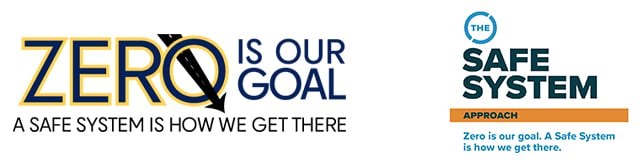
The safe system approach is different. It is about concrete decisions, and the way that is applied in New Zealand and Australia includes modelling changes on the network, what it costs, and whether and then how it moves the dial. You can watch this distinction play out in real time at the US federal level — even in the branding. The familiar Vision Zero logo has quietly disappeared from federal safety materials, replaced by a Safe System logo.
Notably, that new logo still speaks to zero deaths: “zero is our goal, a safe system is how we get there”, but without ever naming Vision Zero. Perhaps the previous brand has simply lost some of its lustre: an easy thing to declare, a harder thing to deliver. The ambition survives; the slogan is being allowed to fade, while the safe system approach is rising and now front and centre.
The New Zealand way: envisage the future, then act
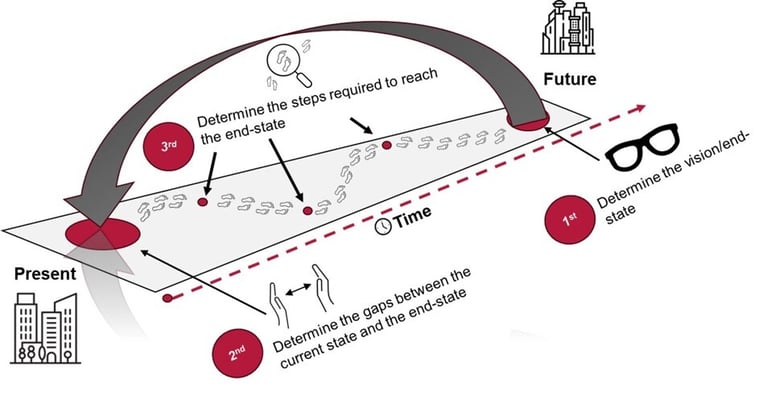
The New Zealand and Australian method starts by envisaging the future, picturing the network we want and working back from it. The logic is simple:
- Define the future state of the network.
- Evaluate the current state.
- Measure the gap.
- Identify solutions to bridge it.
- Prioritise within a real budget.
The future state is not “zero deaths”. That is a vision. For example, on New Zealand's rural roads in 2050, the end-state for two-lane undivided roads could be a safe and appropriate speed limit of around 40–50 mph, supported by forgiving infrastructure: flexible centreline and side barriers on higher-risk sections, sealed shoulders, audio-tactile line marking, and better delineation through high-risk curves. In short, a road designed so a normal human body, not Graham's, can make a mistake and still walk away.
Crucially, envisaging the future forces us to test every segment of the safe system, not just the comfortable ones: safer roads through infrastructure, yes, but also safer speeds, including safe and appropriate limits and their enforcement, and safer people through education and enforcement. Speed and enforcement make some audiences twitch. But you cannot picture a safe future honestly and then leave out the politically awkward parts or if you do, expect to overinvest in infrastructure with a corresponding reduced benefit cost ratio.
From map to programme
This is where demonstrable tools earn their keep. The SafeRoads analysis Abley piloted across Georgia, covering every road in the state and not just one county, models that future-state network and lets decision-makers test it, dialling countermeasures up or down to see what changes. It gives a network-wide view of expected safety performance right down to the individual segment, so the underperforming roads reveal themselves.
The Georgia results show what that looks like in practice. Just 6% of rural roads, rated one or two stars, yet accounted for 20% of all rural fatalities and serious injuries across a decade — more than 6,000 people. Upgrading those 1,819 miles of state road to meet the three-star global safety target would save approximately 125 deaths and serious injuries every year. Scaled to Georgia's full rural network, the potential saving rises to 387 lives annually.
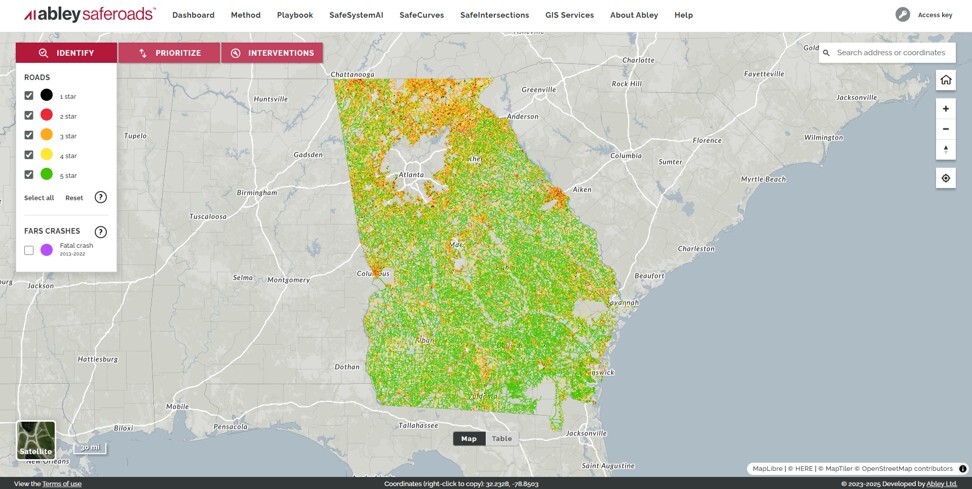 Georgia's rural road network rated by star rating, SafeRoads analysis
That turns analysis into a decision. Agencies can see exactly which roads to treat first, what the safety return on that investment looks like, and how the numbers shift if they extend the programme or adjust the budget.
Beyond a duty of care
The profession's own conscience is moving in the same direction. ITE's long-standing Canon of Ethics asks members to have “due regard” for the safety, health, and welfare of the public, in effect a duty of care. But ITE's newest move, the Safety Roadmap and Action Plan 2025–2027, deliberately pushes past that passive standard, asking professionals to embed safety proactively into their decisions, backed by an ITE Safety Pledge and a shift toward zero roadway fatalities. The direction is unmistakable: beyond a duty of care, toward active safety leadership.
That reframing sharpens the case against the most seductive excuse of all: let's just wait for safer vehicles.
Don't wait for safer vehicles, either
Safer vehicles matter enormously; they are a genuinely important part of the safe system, and the newest evidence is striking. Waymo, the autonomous ride-hailing company, has now driven more than 170 million rider-only miles. The independent Insurance Institute for Highway Safety recently found its vehicles involved in roughly two-thirds fewer police-reportable crashes than human drivers over about 50 million miles, and Waymo's own analysis reports far larger reductions in the injury crashes that harm pedestrians, cyclists and motorcyclists. Where it operates, the technology is genuinely safer.
But scale is everything, and here the numbers are humbling. The United States has around 290 million registered vehicles that together drive roughly 3.3 trillion miles a year. Waymo's entire history of autonomous driving, every mile it has ever logged, adds up to well under an hour of the nation's ordinary traffic. Today's autonomous vehicles are a rounding error against the whole fleet.
So when might they actually move the national numbers? To make a measurable dent, autonomous vehicles must cover a few percent of those 3.3 trillion miles, thousands of times their current scale. Even if they double their mileage every year, that is the better part of a decade just to approach one percent, and the fleet turns over slowly: the average American car is already more than twelve years old. A realistic estimate puts any measurable nationwide safety benefit in the 2040s, fifteen to twenty years away, and a dominant one later still. And even then, those vehicles will still need good infrastructure and safe, appropriate speeds. We cannot ask a community to wait two decades for that when we already know how to make their roads forgiving today.
Conclusions
Graham proves we cannot redesign people, so we redesign the road, the speed and the behaviour around them. That is the safe system approach: a method, whereas Vision Zero on its own is only an ethical position. Even the federal branding now tells that story. But the approach is only the real thing if we keep its harder elements, safe speeds and enforcement, and not merely the name.
Envisaging the future turns ambition into engineering: define the end-state, measure the gap, and invest across safer roads, safer people and safer speeds. Tools like SafeRoads make the trade-offs tangible and the investment case defensible, right down to the individual road. And waiting for safer vehicles, when proven alternatives exist now, is ethically indefensible, and out of step with where the profession itself says it stands.
We owe it to our communities to act now. The faster we make real changes, the sooner a life is saved, and saved for every year that follows. Our work is only beginning, especially in the US. Other countries have shown the way and it involves applying the safe system approach.