

 Built for Cheap Oil: Are Our Cities Ready?" style="object-fit: cover;object-position: top;width:100%;height:100%;" fetchpriority="high" decoding="sync"/>
As the conflict in the Middle East continues to rattle global energy markets and oil prices surge to levels not seen in years, a question that urban planners have long deferred is now impossible to ignore: how resilient are our cities to a sustained oil crisis? Research published by Rendall, Page, and Krumdieck offers a framework for understanding oil vulnerability across urban areas.
The Vulnerability to Oil: Income, Land-Use and Accessibility (VOILA) assessment moves beyond traditional oil vulnerability measures by examining not just how much fuel households consume, but whether they have any realistic alternatives if they can no longer afford it.
During an oil crisis travellers are faced with only three choices. The first is to maintain current travel patterns by spending more on fuel. The second is to adapt their travel, either by shifting mode to public transport, walking or cycling, or switching to closer activity destinations, which is only an option for some trips. If it isn’t possible for someone to maintain or adapt, their only choice is to forgo activities, which is the worst possible outcome for people’s social wellbeing and the economy.
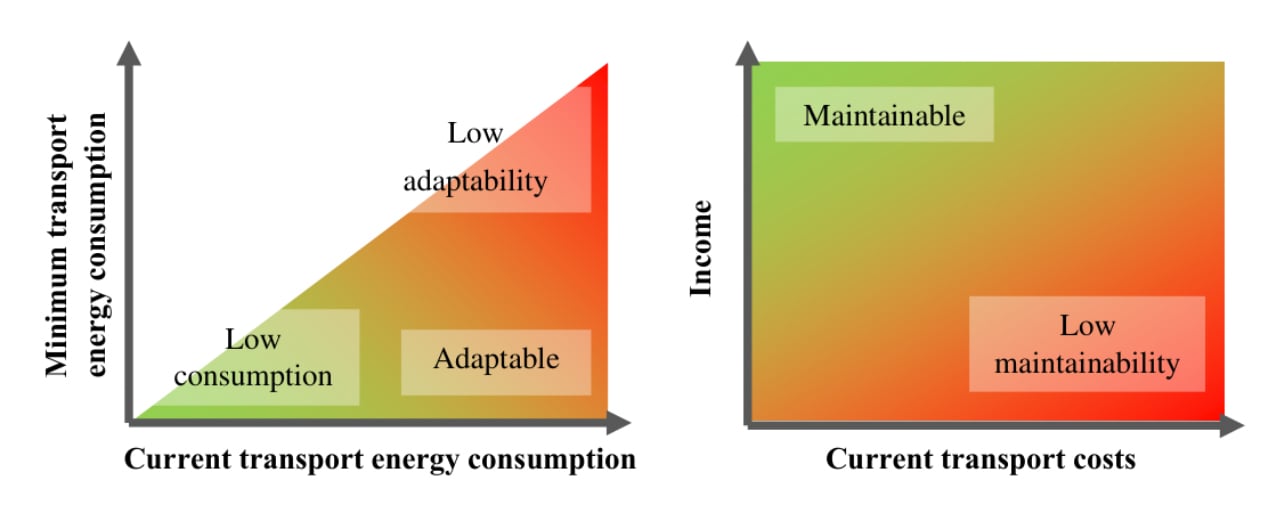
Conceptual diagrams of adaptability and maintainability
The VOILA model uses spatial data of transport networks, destinations and existing vehicle use to quantitatively measure residents’ ability to adapt or maintain during an oil crisis. Areas that score poorly on both categories are genuinely vulnerable, these are the areas in which residents are likely to be forced to forgo travel to education, shopping and employment because they have no other option.
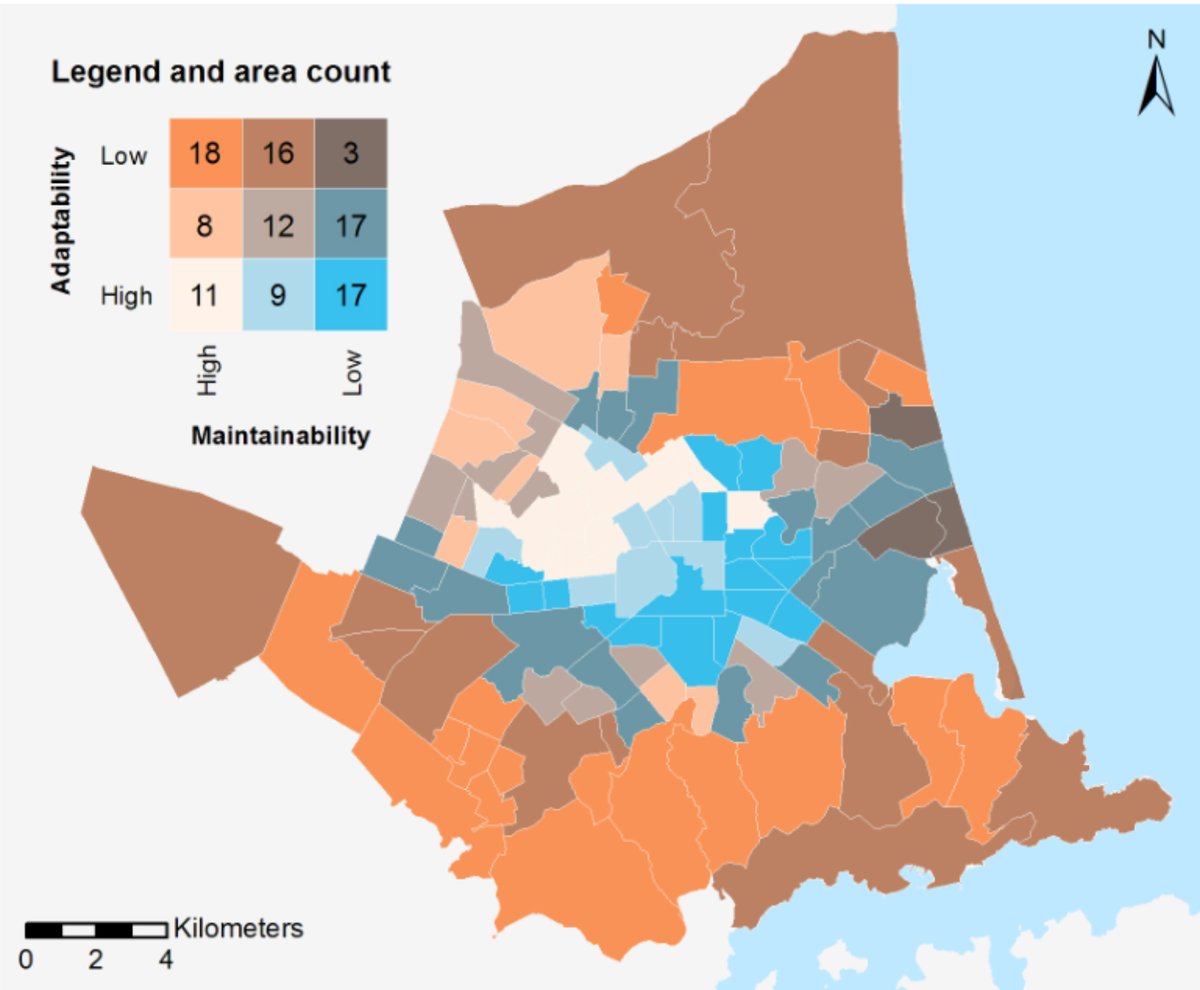 VOILA analysis of Christchurch by census units
Applied to Christchurch, New Zealand, the findings are striking. Areas close to the central city are readily able to adapt or maintain due to higher incomes, good public transport and simply being close enough to switch to walking or biking to a wide range of destinations. However, further out from the central city the picture rapidly changes. Lower incomes are compounded by a lower density of opportunities combined with decades of underinvestment in public transport and limited walking/cycling facilities to severely limit the potential for adaptation. Nearly one third of the city scores medium or low in one category and low in the other, representing the highest risk areas. Authorities urgently need to target these areas for interventions, such as financial relief in areas with lower maintainability and a rapid improvement in public transport for areas with lower adaptability.
Our cities have been built in an era of cheap oil, with forward planning based on the assumption that oil would always be low cost and readily available. This has produced cities that are structurally dependent on cheap plentiful oil: sprawling, low-density, lacking walking/cycling facilities and poorly served by public transport.
With geopolitical uncertainty showing no signs of easing, the relevance of this research has never been sharper. Cities built around car dependency, sprawling, low-density, poorly served by public transport, are structurally exposed. The lesson for urban planners and policymakers is clear: resilience cannot be retrofitted during a crisis. Investments in public transit, mixed-use density, cycle networks and walkable neighbourhoods are not lifestyle amenities: they are critical infrastructure for an oil-constrained future.
Read the full paper: https://ir.canterbury.ac.nz/items/c67a34af-599d-4efd-a650-4a7260d73d21