


Roading is typically the single largest asset class on a council balance sheet. How it is valued affects depreciation, maintenance, investment, renewals and, ultimately, how councils understand the scale of the system they are responsible for managing – a key theme of the recently-released National Infrastructure Plan.
In 2024, the Ministry of Transport initiated a research project to improve these valuations by developing a nationally-consistent valuation methodology for local roads. Abley partnered with Anthony Byett to conduct this research, which has recently been published (summary, full report).
How it’s done currently
Most councils value physical roading assets – pavements, bridges and structures – using well‑established methods which are fairly consistent across the country. These valuations are audited and updated regularly.
Land under roads is treated very differently. Some councils value road land at historic cost, i.e., what was paid for the land when the road was built – even though this may have been decades ago. Others apply nominal values or exclude road land entirely. Even where land is valued, the underlying land valuation data is often old and applied inconsistently. This contrasts with the NZTA Waka Kotahi approach to valuing state highways, which uses an “over‑the‑fence” method that estimates land value based on recent valuations of adjacent properties.
The result is a patchwork of practices that make it difficult to compare road asset values between councils, or between local and state networks. Previous research compiling council and NZTA valuations showed that the state highway was valued roughly six times higher per kilometre than the local road network. While there are real differences in the types of roading assets that make up these two networks, this discrepancy highlighted that there may be substantial under-valuation of local roads by councils.
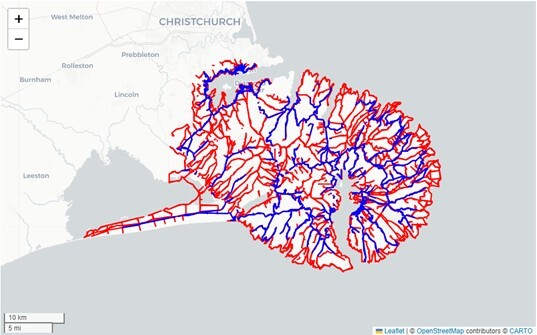
Figure 1 - Banks Peninsula formed roads (blue) and paper roads (red)
Our research
After reviewing valuation literature and current practice for local authorities and the NZTA, we developed a valuation approach which used different methods for land and non-land assets. Non‑land assets were valued based on council‑reported values, with adjustments to identify and correct outliers. Land was valued using an over‑the‑fence approach, similar to that used currently by NZTA.
The valuation of land under roads is a thorny issue, since these roads are not typically bought and sold on an open market. The NZTA approach assumes that state highway land has the same average value as adjacent properties. From a replacement cost perspective this make sense, as rebuilding the road elsewhere would involve buying another comparable piece of land at market prices. In urban areas this gets trickier, as the presence of the road itself – and its associated positive and negative effects, such as access, noise and pollution – are expected to have an influence on adjacent land values. In the end, we used adjacent land values averaged at both the SA1 or SA2 (with Stats NZ statistical boundary definitions) level, to reflect a range of possible local impacts on land values.
The findings
Our approach was tested across five case study areas spanning different urban and rural contexts, including Wellington City, the Newtown suburb of Wellington, Upper Hutt, the Totara Park suburb of Upper Hutt and Banks Peninsula. Across these case study areas, we found that non-land asset valuations were relatively consistent. Our updated land valuations accounted for between 48-93% of overall asset value across the case studies – a significant increase over council-reported valuations.
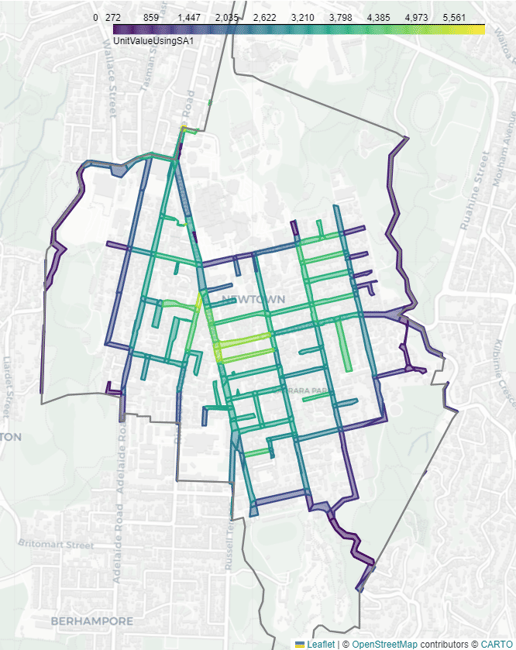
Figure 2 - Newtown road parcels and indicative land value per square metre
Applying our land valuation approach to the nationwide local road network, we estimated total land value of between $215 billion and $260 billion. This represents a three‑ to five‑fold increase on 2018 council estimates. In terms of practical impact on councils, total reported council assets (all assets, not just roads) were $183 billion in 2023, meaning that applying this valuation approach could almost double council balance sheets.
Future steps
Our research concluded with a rollout plan to apply the valuation approach across Aotearoa New Zealand. Based on our case study findings, a rollout of an updated valuation approach could have very significant effects on councils’ understanding of their asset values, and subsequently how they maintain, insure, invest in, and fund road networks into the future.
Get in touch with Abley's Modelling & Economics team to explore how we can support your research, asset data and valuation needs.